
Free Estimate
888-698-1958
Call for Priority Scheduling
888-698-1958
Call for Priority Scheduling
Book Online
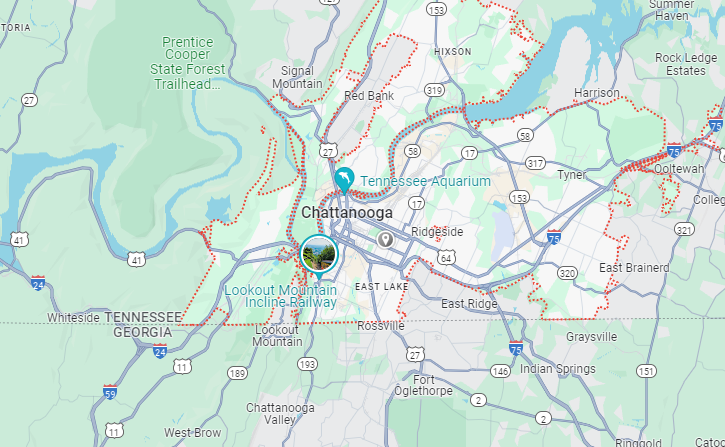
Keep your basement dry and protected with professional basement waterproofing in Chattanooga, TN. The team at 58 Foundations & Waterproofing has the experience and solutions to handle the city’s unique moisture and drainage issues.
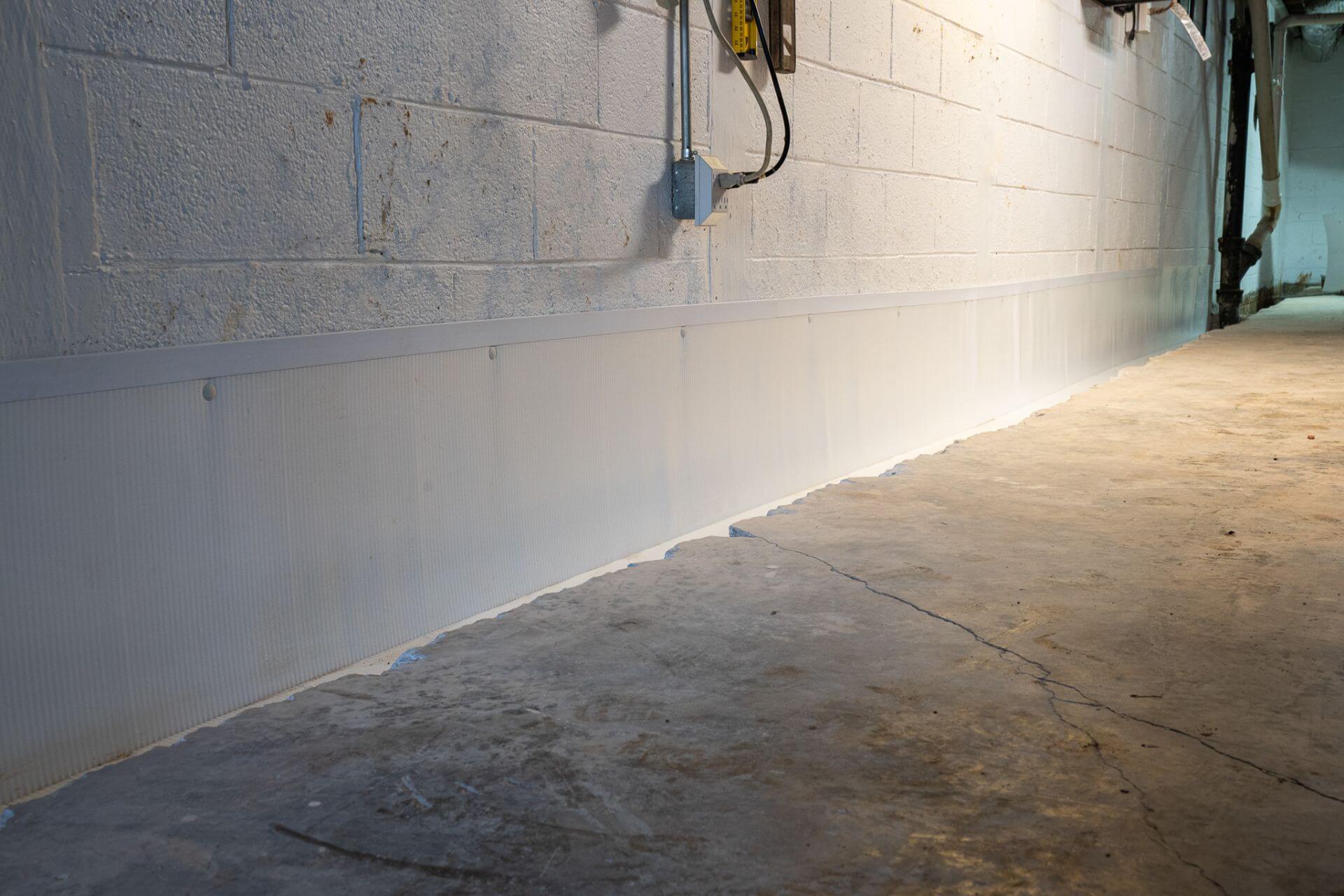





Chattanooga sits in a bowl. Lookout Mountain, Missionary Ridge, and Signal Mountain ring the city, and when it rains, that water runs downhill toward the neighborhoods below. Basements here deal with seepage, standing water, mold, and damaged walls, and the problems tend to get worse the longer they go without attention.
'58 Foundations & Waterproofing has been doing this work since 1958. Our Certified Foundation Specialists handle everything from interior drainage and sump pump systems to vapor barriers and humidity control, and every inspection comes free with a written estimate.
The red clay soil that covers most of Hamilton County is the starting point for most basement water problems here. Clay absorbs water slowly and holds it long after the rain stops, keeping the soil around foundation walls saturated for days at a time. As it absorbs moisture, it expands, pressing against the foundation. When it dries out, it shrinks and pulls away, leaving gaps where the next rain can penetrate deeper and faster. That cycle repeats every wet season.
The terrain makes it worse. Homes built on or below the slopes of Lookout Mountain, Missionary Ridge, and the ridgelines throughout the county sit in the path of significant stormwater runoff. When rain falls on those slopes, it moves fast and collects against whatever is downhill, often a foundation wall. Lots with poor grading or aging downspout systems that discharge too close to the house add to that load.
Chattanooga also averages 52 inches of rainfall a year, spread across a long humid season that keeps ambient moisture elevated even between storms. For below-grade spaces, sustained humidity means vapor continues pushing through porous concrete and block walls even when there's no active rain event driving it.
Chattanooga basements take a beating that builds up over the years. The signs that show up first are easy to explain away: a smell that comes and goes, a wall that looks a little off, a stain that wasn't there last spring. Most of them are worth taking seriously.
Look at the base of any metal in the basement. Column feet, anchor bolts, pipe brackets, and old water heater stands all show rust when they've been sitting in periodic moisture long enough. The streaking tends to spread outward across the floor or down the wall from the source. It's not cosmetic. It's a record of how long water has been present. Learn more about rust stains in the basement.
Moisture works from the bottom up in finished basement walls. The first signs are usually a soft, slightly swollen strip along the base of the wall, paint that has lost adhesion in a band near the floor, or a corner bead that has begun to separate. By the time those things are visible, the interior of the wall has typically been wet for a while. Learn more about water-damaged drywall.
Staining that appears after rain and lightens as the basement dries out is telling you water is entering the same way every time. It may be a faint tide line on the floor near a wall, a darker patch on bare concrete that never fully dries, or a yellowish discoloration that has gradually grown larger over several seasons. Learn more about water stains in the basement.
A basement that stays damp through Chattanooga's long, humid summers is attractive to termites. Signs include a hollow sound when you tap on wood framing near the foundation, fine granular deposits near wood surfaces that look like compressed dust, and thin mud tubes running up masonry walls. Termites don't create moisture problems, but they reliably follow them. Learn more about termite damage.
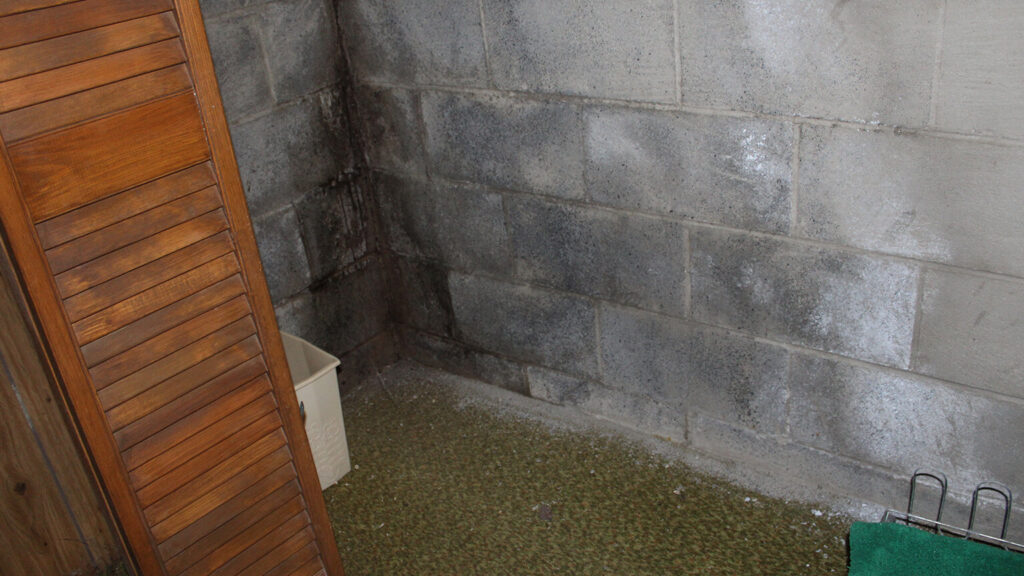
Mold in a basement often establishes itself in places that don't get looked at regularly. The back of a stored box, the underside of a shelf, the gap between a water heater and the wall. It may show as a gray or greenish film, a dark, irregular stain, or a powdery coating on concrete that looks like it could be wiped away. The smell usually arrives before the visible growth does. Learn more about basement mold.
That white powdery deposit on a block or concrete wall has a name: efflorescence. It forms when water carries dissolved minerals through the wall and leaves them behind as it evaporates on the surface. Scrubbing it off clears it temporarily, but it reappears in the same location because the pathway water is using hasn't changed. Learn more about efflorescence.
The smell tends to be most noticeable when the weather has been wet for several consecutive days, or when you first open the basement door after it's been closed up. It comes from microbial activity in damp materials, not from the air itself, and ventilating the space doesn't resolve it. Learn more about musty odors in the basement.
Chattanooga's red clay expands against foundation walls when wet and pulls away when dry, putting the wall through repeated stress cycles. A crack that has developed a white mineral deposit trailing downward, or one that shows dampness in a ring around it after rain, is under active pressure. It will continue to let water through until that pressure is addressed. Learn more about leaking basement cracks.
A floor crack where one side sits slightly higher than the other, or a horizontal crack running the length of a block wall, indicates movement rather than simple settling. These tend to develop gradually and are easy to dismiss early on. In a region where soil pushes hard against foundations through wet seasons, gradual rarely stays that way. Learn more about floor and wall cracks.
Every basement we inspect has its own combination of problems, and what we install reflects what we actually find. We assess each home before recommending anything.
Water that enters through the base of a foundation wall or up through the floor needs somewhere to go before it spreads. Channel 58 interior drainage is installed along the perimeter at floor level, capturing incoming water and directing it to the sump pit continuously and out of sight beneath the finished floor.
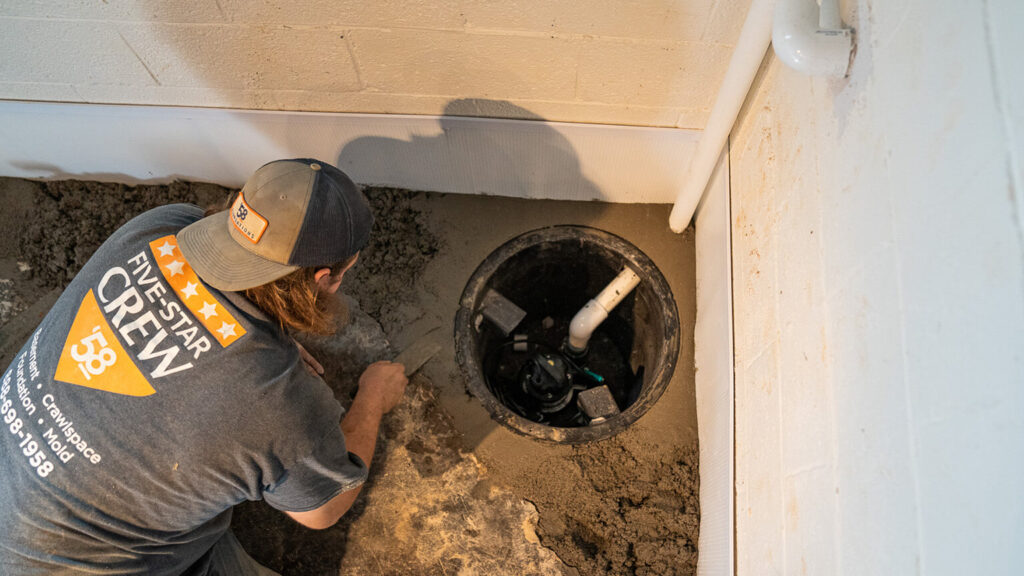
The sump pump is what moves collected water out of the pit and away from the home. When storms knock out power, the Workhorse OT battery backup takes over automatically, keeping the system running without any action needed from the homeowner.
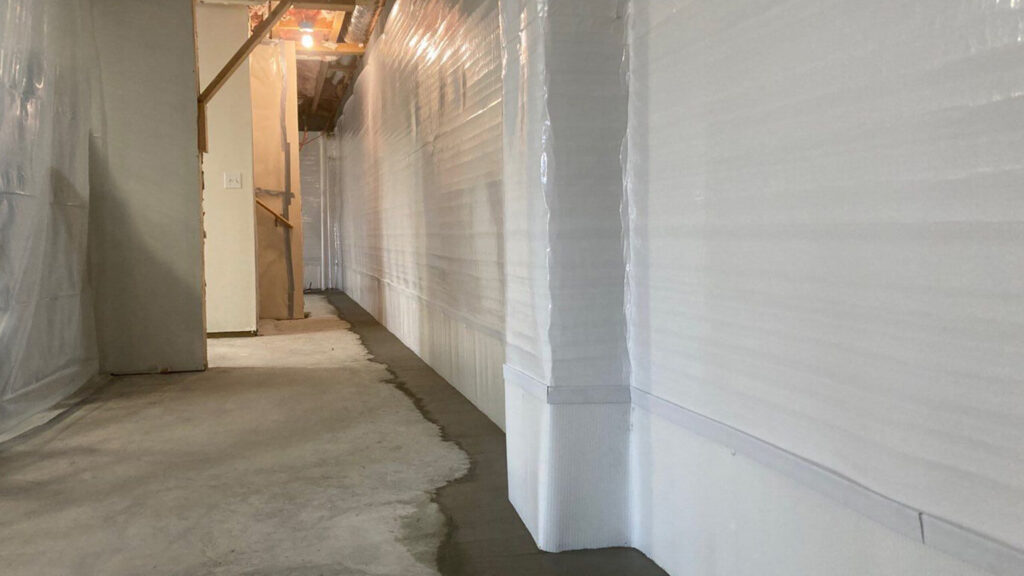
Some moisture doesn't enter as a visible leak. It moves through concrete and block as vapor and raises humidity throughout the space. Vapor barriers and wall membranes stop that transmission at the wall and direct any moisture that does come through into the drainage system below.
Once active water intrusion is addressed, residual humidity can linger and continue to feed mold and odor problems. Our HumidiGuard dehumidifier maintains stable moisture levels in the basement on an ongoing basis, regardless of what the weather is doing outside.
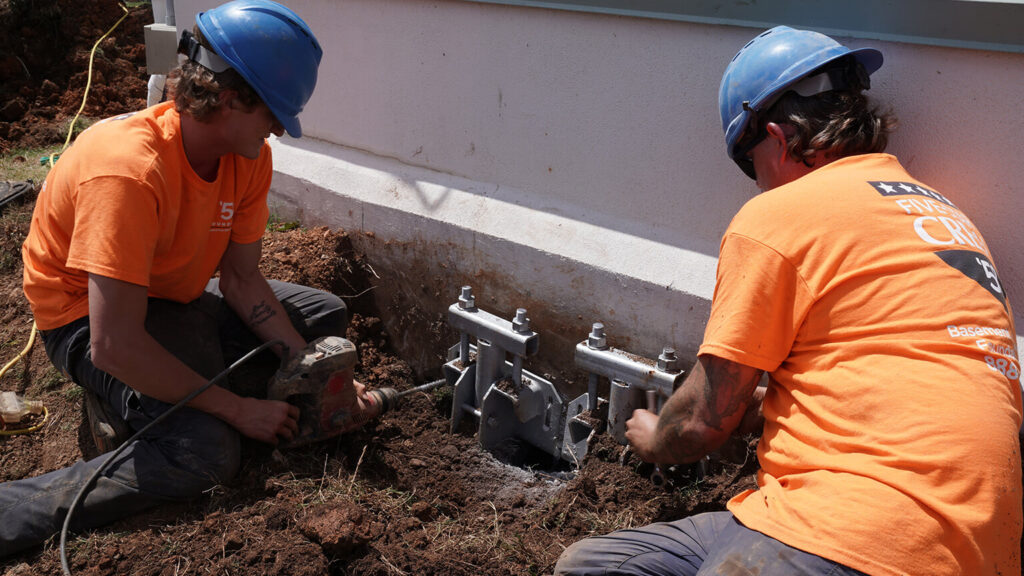
When the grade around a home directs surface water toward the foundation rather than away from it, interior systems carry a heavier load than they should. Exterior drainage addresses that at the source, reducing the volume of water that reaches the foundation wall in the first place.
When moisture has been present long enough for mold to establish itself, it needs to be cleared before waterproofing work begins. We provide professional mold remediation when the inspection finds it.
Our Life-of-the-Structure Warranty backs every system we install. Learn more about our Basement Waterproofing services.»
A sump pump is what stands between a working drainage system and a flooded floor. Water that Channel 58, our interior perimeter drainage system, collects along the foundation perimeter flows to the sump pit, and the pump is what gets it out of the house. If the pit fills faster than the pump can empty it, or if the pump goes down during a storm, the drainage system can't do its job.
Pump capacity matters in a city that averages 52 inches of rain a year. A sustained storm event can move a significant volume of water through a basement in a short period, and a pump that isn't sized to handle that load will fall behind. Our Certified Foundation Specialists determine what the home actually needs based on the size of the space, the drainage configuration, and the conditions we find during the inspection.
Chattanooga also loses power during storms with some regularity, which is exactly when the pump is working hardest. The Workhorse OT battery backup activates on its own when the power goes out and keeps the system running until it's restored. For a basement that took on water the last time the lights went out, that continuity is the difference between staying dry and starting over.
Basement waterproofing estimates in Chattanooga vary because the problem is rarely what it looks like on the surface. A damp corner after heavy rain could trace back to a crack under hydrostatic pressure from saturated red clay, a grading problem sending runoff straight toward the foundation, or a drainage system that worked for years before the surrounding soil shifted. Each of those requires something different, and the inspection is what separates one from another.
Some projects are contained. Others involve the full perimeter. What the Certified Foundation Specialist finds on-site is what drives the scope, not a predetermined package.
These are the factors that shape what a waterproofing project involves:
What You Can Expect
'58 Foundations & Waterproofing provides free inspections with written estimates. Your Certified Foundation Specialist will assess the basement, identify what's driving the moisture, and walk you through what the work involves before anything is scheduled.
Chattanooga has no shortage of contractors who will show up after a wet season and offer a quick fix. What's harder to find is a company that has been doing this work long enough to understand how this city's terrain, soil, and weather actually behave, and that will still be around if something needs attention five or ten years from now.
'58 Foundations & Waterproofing has been in business since 1958. Our crews are our own, not subcontractors, and every inspection is performed by a Certified Foundation Specialist who can tell you exactly what's happening in your basement and why. The BBB has recognized us with the Torch Award for Ethics four times across three regions in three years, and This Old House has cited us as the most experienced company in the industry.
Every system we install is backed by our Life-of-the-Structure Warranty. The protection doesn't expire when the job is finished.
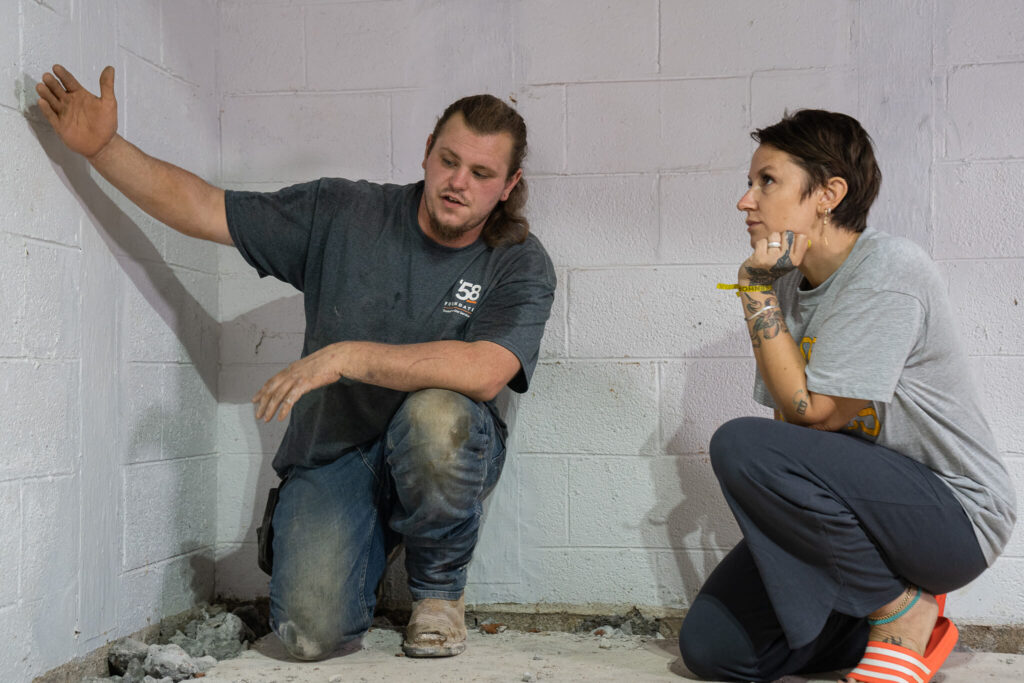
Mold spreads. Drywall that's soft at the base of a wall doesn't firm back up. Cracks that let water through this season will let more through the next. Basement water problems don't stabilize on their own, and the longer they go without attention, the more of the home they affect.
'58 Foundations & Waterproofing offers free inspections with written estimates throughout Chattanooga and Hamilton County. A Certified Foundation Specialist will assess your basement, identify what's driving the problem, and give you a straight answer about what it will take to fix it.
Schedule your free inspection today.
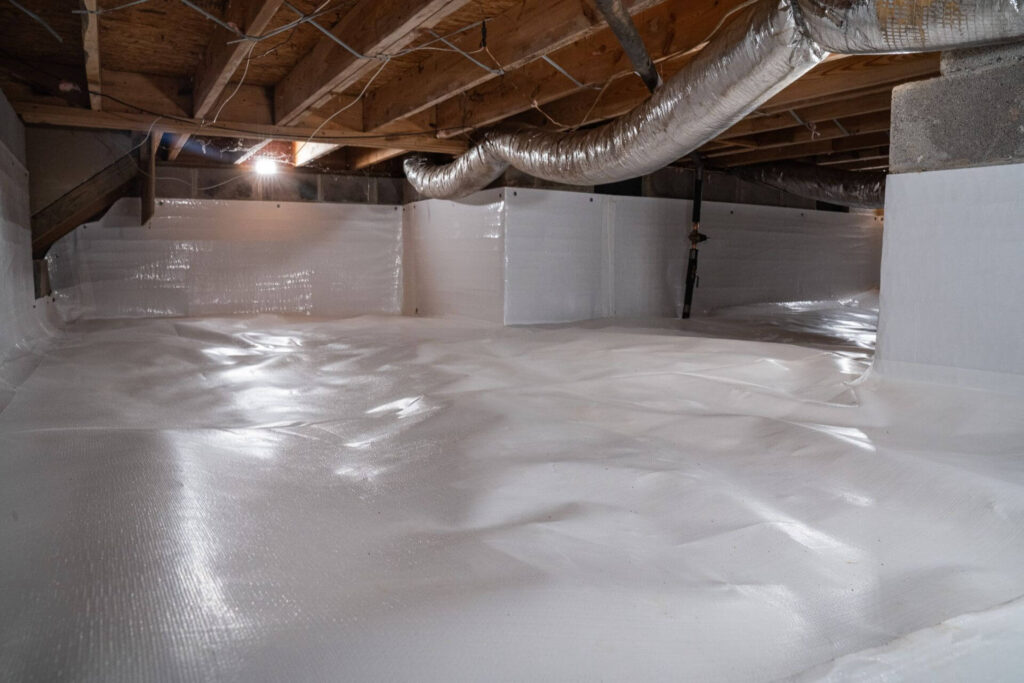
Chattanooga Crawl Space Encapsulation
We respect your privacy. By submitting, you authorize '58 Foundations and Waterproofing to reach you via call, email or text for information about your project needs. We will never share your personal information with third parties for marketing purposes. You can opt out at any time. Message/data rates may apply. Consent is not a condition of purchase. Privacy Policy