
Free Estimate
888-698-1958
Call for Priority Scheduling
888-698-1958
Call for Priority Scheduling
Book Online
If your crawl space came up in a home inspection, or you've noticed a musty smell on the first floor that gets worse every summer, you've probably run into conflicting advice. Some people say you need better ventilation. Others say encapsulation is the only real fix. It's rarely explained clearly enough to know which one applies to your home.
The honest answer depends on where you live. In North and South Carolina, the climate plays a direct role in which approach actually works. Both methods are trying to control moisture in a space that sits beneath your living area and affects everything above it. They go about it differently, and one is significantly better suited to the conditions Carolina homeowners deal with most of the year.
For decades, vented crawl spaces were the default. Building codes across much of the country required foundation vents, and the logic was straightforward: bring outside air in, let moisture-laden air escape, and keep the space dry through passive airflow. The approach was borrowed from attic ventilation, where moving air does help manage moisture. Applied to crawl spaces, the assumption was that the same principle would hold.
Many homes across North and South Carolina still have vented crawl spaces today. If your home was built before the mid-2000s, there's a reasonable chance it has foundation vents that were never sealed or upgraded. That's not a problem requiring immediate action on its own, but it does mean the crawl space is operating on older assumptions about how moisture moves.
Foundation vents were designed for climates where outdoor air is drier than the air inside the crawl space. Pull the drier air in, push the humid air out, problem solved. That logic breaks down in North and South Carolina, where summer air carries enough moisture that introducing it into a cool crawl space makes conditions worse, not better. The incoming air hits cooler surfaces and condenses, leaving wood framing, floor joists, and insulation wetter after the vent does its job than before.
The Carolinas also don't get a long dry season that resets the cycle. Humidity stays elevated from spring through fall, which means a vented crawl space is taking on moisture for the better part of the year with little opportunity to dry out between weather events. By the time a homeowner notices a musty smell or soft spot in the floor, the moisture has typically been accumulating for seasons.
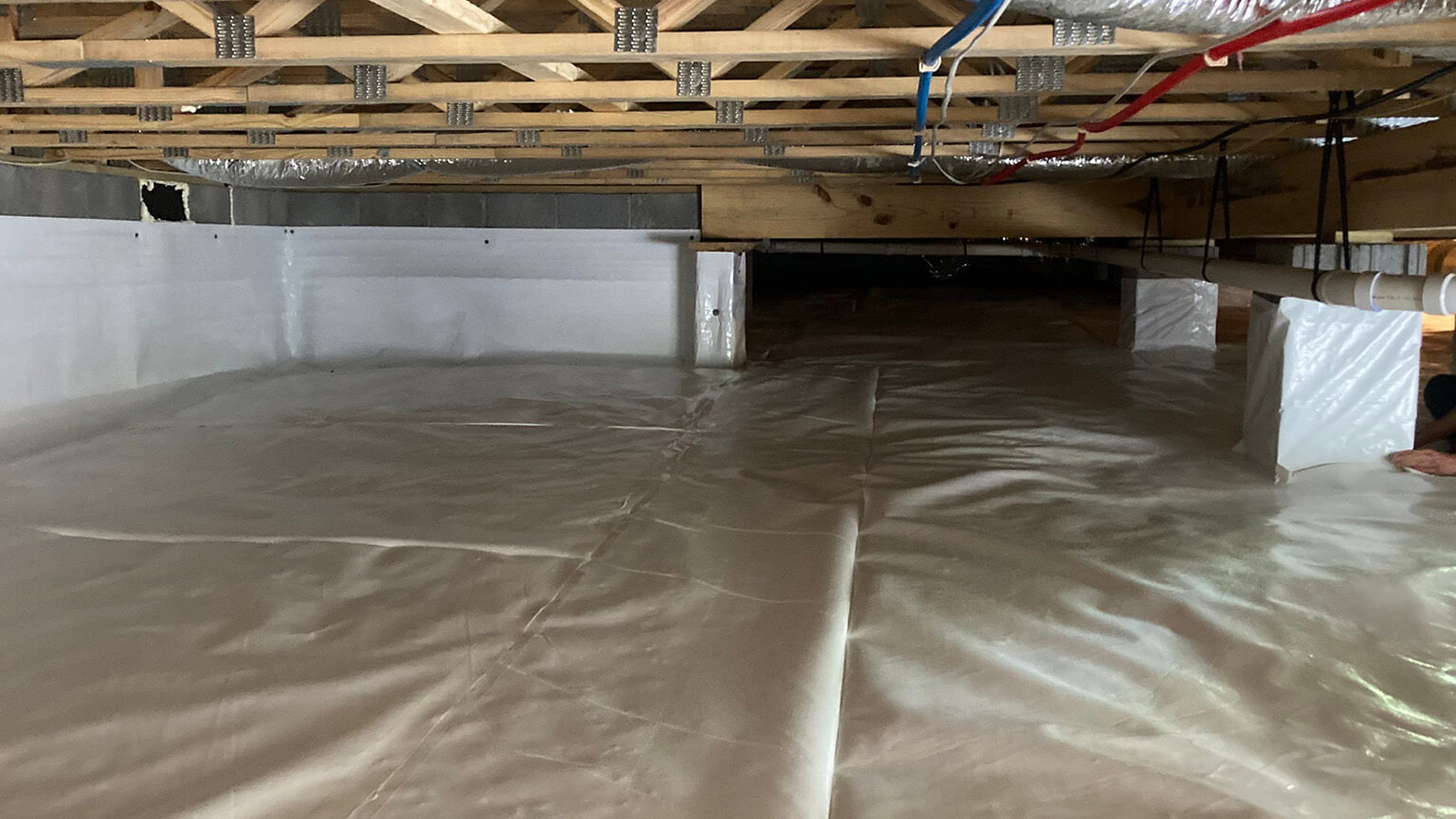
Encapsulation takes the opposite approach from ventilation. Rather than exchanging air with the outside, it seals the crawl space off from it. The crawl space is treated as part of the home's conditioned envelope, and moisture is controlled rather than left dependent on whatever the weather is doing outside.
A full encapsulation system typically includes:
Without the constant influx of outside air, condensation stops forming on wood framing, mold loses the conditions it needs to grow, and the air quality in the crawl space improves. Since crawl space air flows directly into the living area above, that improvement is felt throughout the home. '58 Foundations installs encapsulation systems across North and South Carolina, including the HumidiGuard™ Dehumidifier and Air Filtration System, which is built for the moisture loads Carolina crawl spaces deal with.
Left unchecked, crawl space moisture creates a compounding set of problems that get more expensive to fix the longer they go unaddressed. The most common consequences include:
'58 Foundations addresses these problems directly through crawl space encapsulation, mold removal, and crawl space insulation services across the Carolinas. Catching these issues early makes a meaningful difference in both the scope and cost of the repair.
A few signs point clearly to a crawl space moisture problem. Inside the crawl space, look for visible mold or dark staining on wood framing, insulation that has dropped or feels damp, condensation on ductwork or pipes, and standing water or wet soil. A musty odor when you open the access door is a reliable indicator on its own.If any of those are present, schedule a free inspection with '58 Foundations. We serve homeowners across North and South Carolina, including Charlotte, Raleigh, Asheville, Winston-Salem, Greenville, and Spartanburg.




We respect your privacy. By submitting, you authorize '58 Foundations and Waterproofing to reach you via call, email or text for information about your project needs. We will never share your personal information with third parties for marketing purposes. You can opt out at any time. Message/data rates may apply. Consent is not a condition of purchase. Privacy Policy