
Free Estimate
888-698-1958
Call for Priority Scheduling
888-698-1958
Call for Priority Scheduling
Book Online
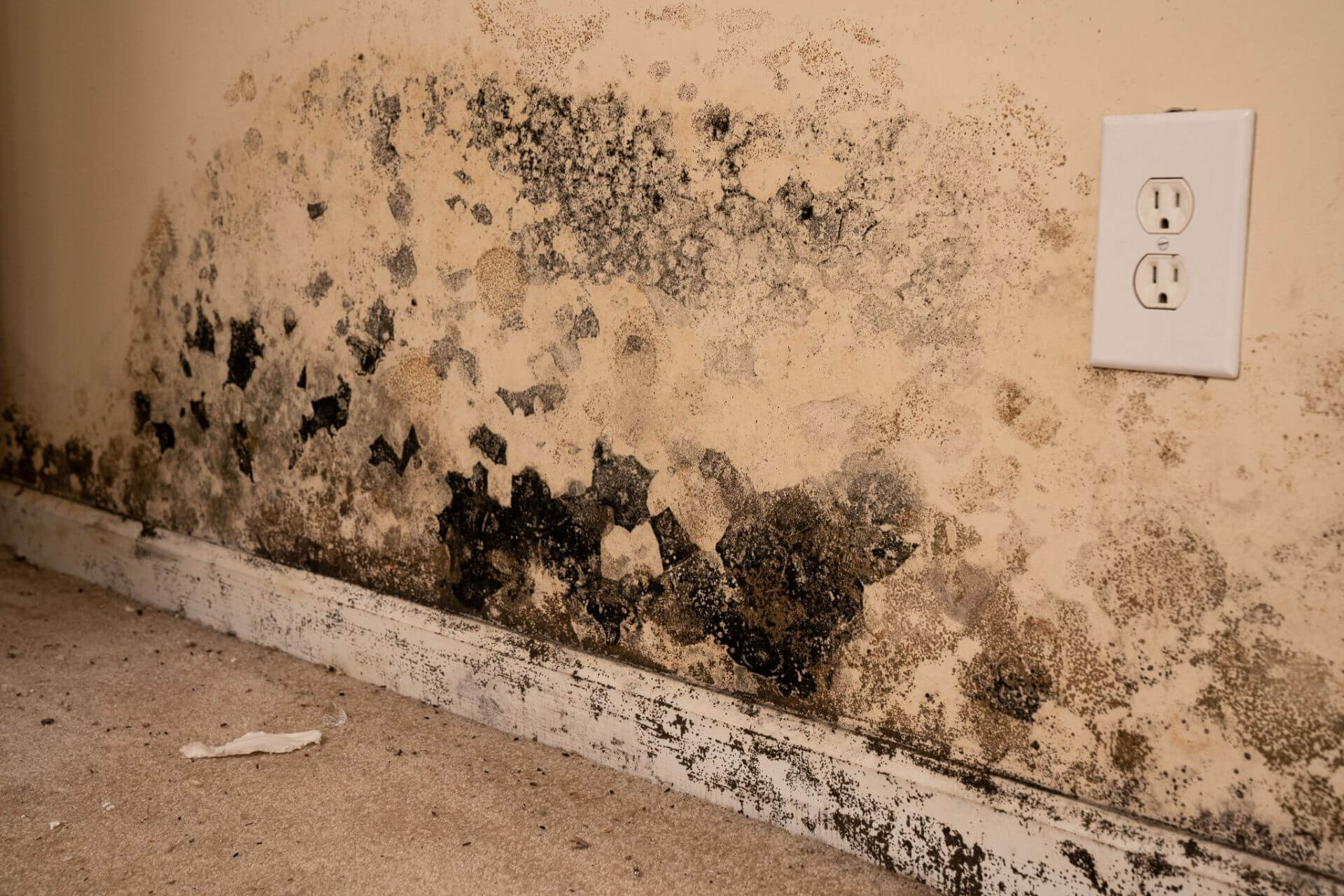
A gray, powdery patch on a basement wall and a dark, fuzzy spot on a floor joist can both get called mildew, but they point to different problems. Knowing the difference between mold and mildew tells you whether you're looking at a surface film you can clean or growth that has worked into the material underneath. Color, texture, and what the growth is sitting on will tell you most of what you need to know. Both need moisture to grow, so finding either one in your basement means water or humidity is getting in somewhere.
There isn't a real difference. Mildew is mold, and the EPA uses the word for certain kinds of mold that grow flat along a surface. FEMA's flood-cleanup guidance calls mildew mold in its early stages. Treating them as two separate problems is a mistake, because it can lead you to wipe away a gray film, call it mildew, and assume the problem is handled.
What gets called mildew is mold growing flat on top of a surface. It can look like a thin gray, white, or yellowish film that feels dry or powdery, sitting on a painted wall, a concrete floor, or a windowsill. What gets called mold is growth that has thickened, with a fuzzy or slimy texture, raised spots, and colors from green to brown to black. Color alone won't settle it, since both can show up in several shades.
Either way, you're looking at the same kind of growth at different stages, and both mean moisture is reaching that surface. What matters is whether the growth is still sitting on top or has worked into the material underneath.
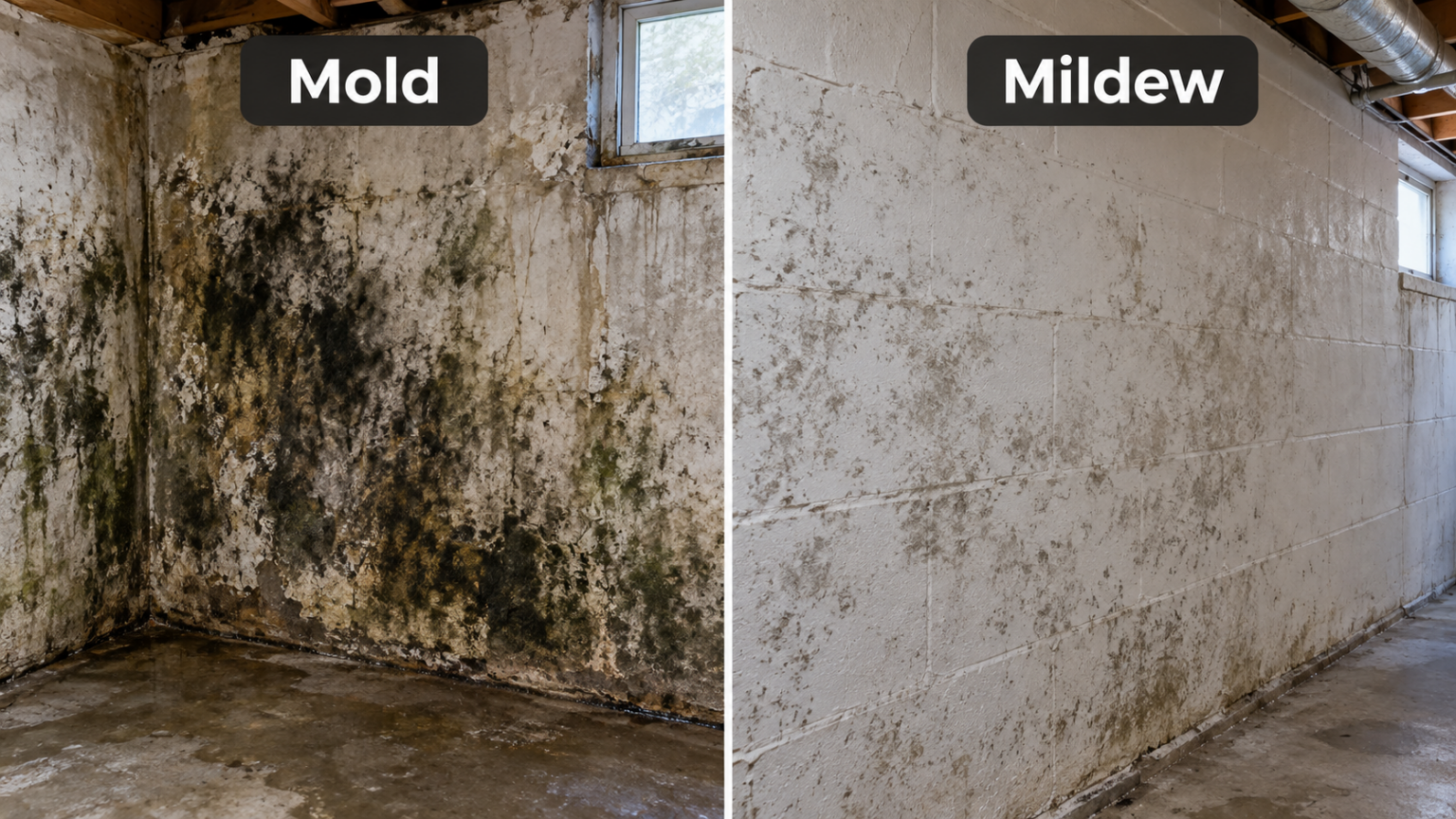
What the growth is sitting on tells you more than its color does. The EPA notes that molds come in many colors, including white and black, so a light gray film can be just as much a mold problem as a dark one. Mold on a hard surface can be cleaned off, while mold on an absorbent material can grow into it and stay there.
Metal ductwork, pipes, glass, and plastic storage bins give mold nothing to grow into. On surfaces like these, the EPA recommends scrubbing the growth off with detergent and water and drying the area completely. If it comes back in the same spot, moisture is still collecting there, whether from condensation, a leak, or humid air.
Drywall, wood framing, carpet and padding, ceiling tiles, insulation, and cardboard all absorb moisture, and mold can fill the small spaces inside them. The EPA warns that mold in absorbent materials may be difficult or impossible to remove completely, and that items like ceiling tiles and carpet may need to be thrown away. A stain that won't clean up, or material that feels soft or crumbles, points to growth below the surface. Painting over it won't fix anything, since the EPA notes that paint applied over moldy surfaces is likely to peel.
Some of what looks like mildew on a basement wall isn't growing at all. Concrete and block walls can carry mineral deposits and rust stains in the same damp spots where mold shows up. What the stain is sitting on, and how it looks up close, will tell you which one you have.
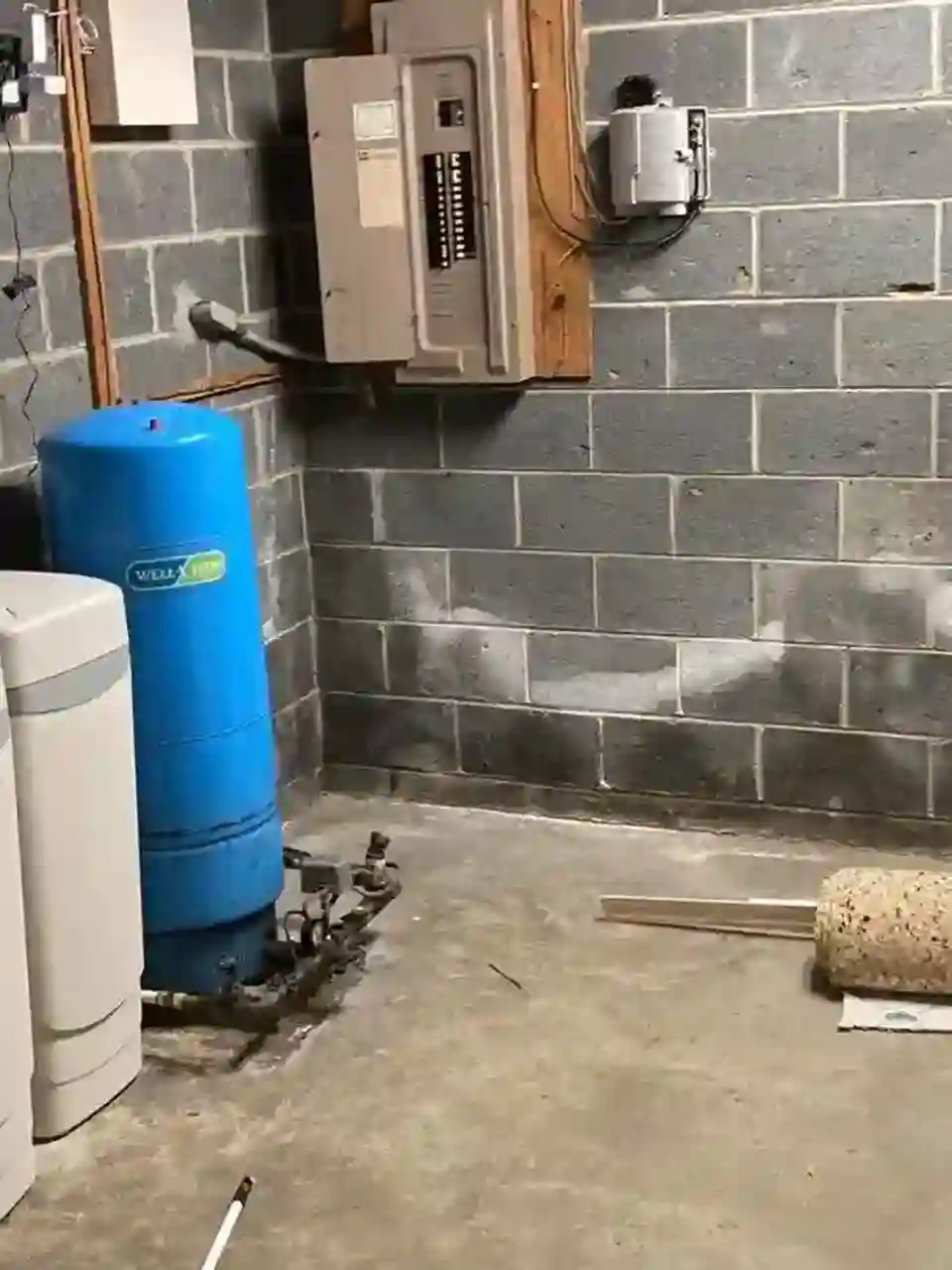
Efflorescence is a white, chalky deposit on concrete or block walls. It forms when water moves through the wall, dissolves minerals inside the masonry, and leaves them behind as a powder when it evaporates at the surface. Because it comes from the masonry itself, efflorescence shows up on concrete, block, and brick, while mold grows on organic material like wood, drywall, and paper. If you find the same white film on a floor joist or the paper face of drywall, you're looking at mold. Efflorescence that keeps coming back after you brush it off means water is still finding a path through your foundation, which is a job for basement waterproofing.
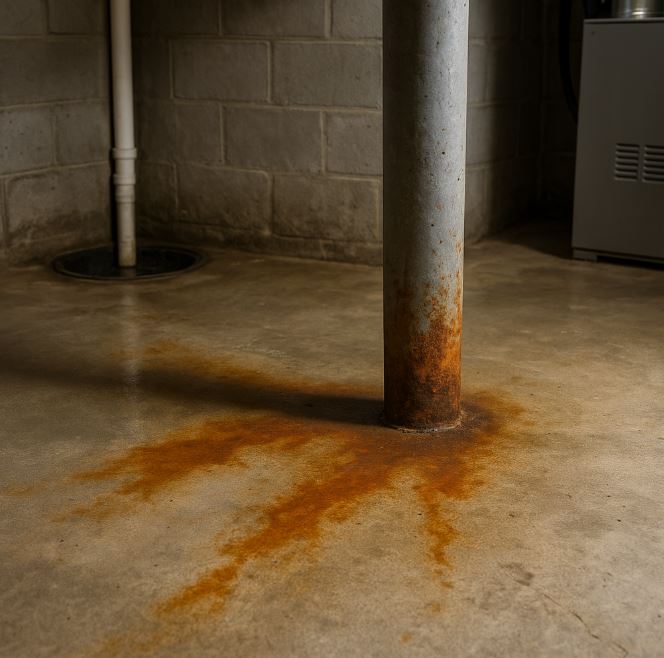
Orange or reddish streaks near drains, along metal posts, or around a water heater are rust, which forms when metal is exposed to both moisture and oxygen. A thicker orange or reddish sludge in a sump pit, along a wall, or in drain lines may be iron ochre, a jelly-like buildup caused by iron bacteria in the soil combining with water and oxygen. Both are signs of moisture in your basement, and '58's guide to rust stains in the basement covers what each one can point to.
Start with anything that stays cool, damp, or pressed against a wall. FEMA lists wood, drywall, carpet, insulation, ceiling tiles, fabric, and cardboard among the materials mold and mildew grow on, and notes that colonies can start on a damp surface within 24 to 48 hours. In a basement, that puts the framing, finished walls, flooring, and anything you've stored in boxes at the top of the list.
Check cold surfaces next. The EPA points to condensation on windows, walls, and pipes as a sign of high humidity, and to rust on a drainpipe as evidence that water is condensing on it. Look along cold-water lines, at windows, and at the stretch of wall behind furniture pushed up against it, since the EPA names that as a spot where condensation forms.
If your basement smells musty and you can't find the source, the EPA says that's a reason to suspect hidden mold. It can grow on the back side of drywall and paneling, the top side of ceiling tiles, the underside of carpet and padding, and inside walls around leaking or sweating pipes. Disturbing those spots to look can release a large amount of spores, and the EPA gives the example of pulling off wallpaper with mold growing underneath. If you think mold is hidden, the EPA suggests hiring an experienced professional.
A humidity reading tells you whether the air itself is feeding the growth. The EPA recommends keeping indoor relative humidity below 60 percent, and ideally between 30 and 50 percent. You can check it with a humidity meter, which the EPA describes as a small, inexpensive instrument that costs $10 to $50 at many hardware stores.
Leave the meter in your basement for a few days and check it at different times, including after a heavy rain. If the reading stays above 60 percent, humidity in the air can be enough on its own to feed mold, even with no visible leak. The EPA lists dehumidifiers and air conditioners among the ways to bring humidity down, along with insulating cold-water pipes so condensation doesn't form on them. '58 installs basement dehumidifiers built for below-grade spaces, with air filtration included.

The EPA's main guideline is size. If the moldy area is less than about 10 square feet, roughly a 3-by-3-foot patch, you can handle the cleanup yourself in most cases. Larger areas, mold that followed significant water damage, and growth caused by sewage or other contaminated water call for someone with experience cleaning up mold. The EPA doesn't recommend bleach as a routine part of mold cleanup, and notes that dead mold can still cause allergic reactions, so it has to be removed. If anyone in your home has health concerns, the EPA advises talking with a health professional before you start.
Whoever does the cleanup, the moisture source has to be fixed too. The EPA warns that if you clean up mold without fixing the water problem, the mold will most likely come back. Depending on what an inspection turns up, that can mean sealing a leaking crack, adding interior drainage, or bringing down humidity.
'58 Foundations & Waterproofing handles both sides of the problem. The mold removal process starts with an inspection and damage assessment, then contains the affected area, manages airflow with air filtration, removes the mold, cleans the space, and restores it. The work is done by technicians certified by the National Organization of Remediators and Mold Inspectors (NORMI) or the Mold Inspection Consulting and Removal Organization (MICRO).
If you've found growth you can't identify, a musty smell with no visible source, or humidity readings that stay above 60 percent, schedule a free inspection with '58 Foundations & Waterproofing. Plan on about an hour for the visit. It covers your basement or crawl space inside and out and ends with a clear explanation of what was found and what it will cost to fix. Appointments are available weekdays, evenings, and weekends, and booking online takes under two minutes.





We respect your privacy. By submitting, you authorize '58 Foundations and Waterproofing to reach you via call, email or text for information about your project needs. We will never share your personal information with third parties for marketing purposes. You can opt out at any time. Message/data rates may apply. Consent is not a condition of purchase. Privacy Policy